Summary: Oslo Security Conference 2026

The 61st annual Oslo Security Conference, organised by The Norwegian Atlantic Committee, took place on 2nd–3rd February 2026 at the historic University of Oslo Aula. Over two days, senior political leaders, military officials, scholars, and experts from across the transatlantic community gathered to discuss the future of Euro-Atlantic security under the theme “The Transatlantic Partnership – Facing the ‘New Normal’”.
The theme reflected a profound shift in the international security environment. The liberal, rules-based international order is under pressure from both external and internal forces, shaped by Russia’s ongoing war against Ukraine, rising great-power competition with China, and significant changes in U.S. foreign policy under the second Trump administration. Against this backdrop, the conference explored how the transatlantic community can safeguard their security interests and adapt to a rapidly changing strategic landscape.

Day One: Europe Navigating the “New Normal”
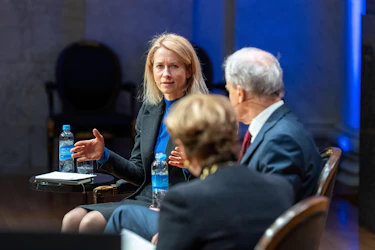
The conference was opened by Kate Hansen Bundt, Secretary General of The Norwegian Atlantic Committee. The opening session featured Prime Minister of Norway Jonas Gahr Støre and EU High Representative and Vice-President of the European Commission Kaja Kallas, in conversation with Bundt.
Prime Minister Støre addressed the strategic consequences of a deteriorating security environment for Europe and Norway. He underlined the importance of allied cohesion, respect for international law, and a strong transatlantic partnership at a time when the foundations of the rules-based order are under pressure. Støre firmly rejected claims questioning NATO’s relevance and warned against undermining collective defence and multilateral cooperation. Several media outlets also highlighted his direct response to President Trump’s NATO rhetoric, underscoring Norway’s commitment to the Alliance and to a rules-based international order.

Kaja Kallas focused on Europe’s security outlook in an era marked by Russian aggression, geopolitical rivalry, and uncertainty surrounding U.S. policy. She stressed the need for European unity, continued support for Ukraine, and a realistic approach to defence and deterrence. Kallas also addressed the debate on European defence cooperation, highlighting both its potential and its limitations within the broader transatlantic framework.
Both remarks received significant media attention:

The opening session was followed by a conversation with NATO Deputy Secretary General Radmila Shekerinska, who addressed the future of transatlantic relations, NATO’s adaptation to the changing strategic environment, and the importance of maintaining credible deterrence and defence across the Alliance.

The “MAGA World Order” and Transatlantic Implications
The following session focused on “The MAGA World Order and its Consequences for the Transatlantic Partnership.” The panel explored the strategic implications of the second Trump administration’s foreign policy, including its approach to alliances, multilateral institutions, trade, and the use of power in international relations.
The panel examined whether recent U.S. policy represents a deeper structural shift in American foreign policy or is primarily driven by leadership style. Panelists assessed which elements of current U.S. strategy are likely to endure and how these developments could shape the future of NATO, European security, and the global order.
The remarks by panelist Lt. Gen (ret.) Ben Hodges, former Commanding General of US Army Europe, was highlighted in the coverage by British newspaper The Guardian.

Norway and Poland: Close Allies in Northern Europe
After lunch, a dedicated session brought together Espen Barth Eide, Minister of Foreign Affairs of Norway, and Radosław Sikorski, Deputy Prime Minister and Minister of Foreign Affairs of Poland, for a conversation on allied cooperation in a deteriorating European security environment. The conversation highlighted the increasingly close strategic alignment between Norway and Poland, particularly in their shared assessment of Russia as the primary threat to European security. Both ministers emphasised the importance of sustained support for Ukraine, stronger European responsibility within NATO, and closer cooperation among capable allies in Northern Europe. The conversation also addressed how bilateral and regional partnerships can complement NATO and EU frameworks at a time when unity and resolve are essential for maintaining deterrence and stability across Europe.

How to deter Russia while carving out a future path for Ukraine.
The discussion addressed long-term deterrence, Ukraine’s strategic options, the importance of sustained military, political, and economic support to Ukraine, and the implications of different outcomes of the war for European and transatlantic security.

The last panel of Day One examined Europe’s response as a strategically fragmented actor. Panelists discussed how diverging threat perceptions, national priorities, and defence postures complicate Europe’s ability to act cohesively, and explored how greater coordination and collective action could strengthen European and transatlantic security.

Day Two: Maritime Security and Global Interlinkages
The second day of the conference focused on the geostrategy of the maritime domain, with particular attention to the North Atlantic and the High North. Opening remarks were delivered by Andreas Flåm, State Secretary in the Norwegian Ministry of Defence.

Discussions addressed Norway’s role as a key NATO ally in the High North, the modernisation of the Royal Norwegian Navy, and the importance of allied maritime cooperation to ensure deterrence and reinforcement in a crisis or conflict. The sessions also examined how developments in the North Atlantic are increasingly linked to global maritime competition.

A dedicated panel on U.S. Asia policy and its implications for Europe explored how U.S. strategic focus on China affects European security. Speakers highlighted the growing interdependence between the Euro-Atlantic and Indo-Pacific theatres and the need for closer coordination among allies to manage simultaneous challenges from Russia and China.

More media coverage from the whole conference
Watch the recorded sessions from the Oslo Security Conference 2026 here
